ONLINE MODULE #3
THE LEARNING THEORIES
THREE LEARNING THEORIES : THE AUDIO-VISUAL VIEW
Learning Theories are conceptual frameworks that describe the manner in which the information is absorbed, processed and retained during learning. Often, the same content can be presented in different ways. Learning Theories provide a framework for such learning solutions.
The Learning Theories are :
- Behaviourism
- Cognitivism
- Constructivism
The factors that influence learning are:
- Cognitive
- Emotional
- Environmental
- Prior experiences
BEHAVIOURAL THEORY
- Behaviourism is based on observable changes in behavioural patterns.
- It focuses on a new behavioural pattern being repeated until it becomes automatic.
- The learner depends on an instructor for acquisition of knowledge.
COGNITIVIST THEORY
- Cognitivism is based on the change in behaviour through sequential development of an individual’s cognitive abilities.
- It indicates the thought process inside the learner’s mind.
CONSTRUCTIVIST THEORY
- Constructivism explains the manner in which knowledge is constructed.
- It focuses on construction of knowledge when the information obtained comes in contact with the knowledge acquired by experiences.

Ref : https://elearning.adobe.com/2017/11/3-traditional-learning-theories-and-how-they-can-be-used-in-elearning/
THE MODELS OF LEARNING
THE INFORMATION PROCESSING FAMILY
THE MODELS OF LEARNING
THE INFORMATION PROCESSING FAMILY
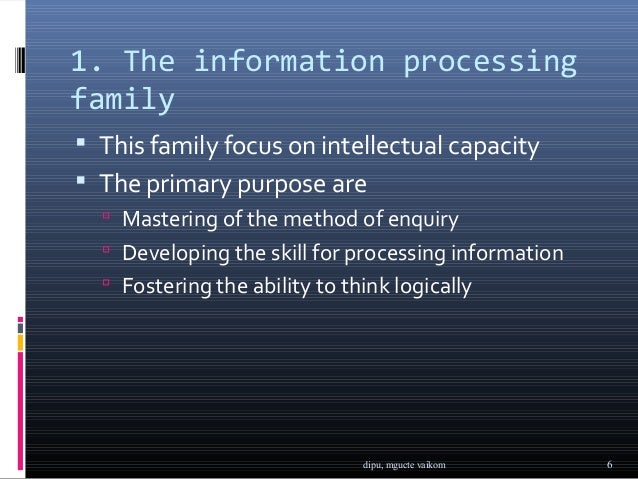
The information processing theories approach to the study of cognitive development evolved out of the American experimental tradition in psychology. Developmental psychologists who adopt the information-processing perspective account for mental development in terms of mature changes in basic components of a child’s mind. The theory is based on the idea that humans process the information they receive, rather than merely responding to stimuli. This perspective equates the mind to a computer, which is responsible for analyzing information from the environment. According to the standard information-processing model for mental development, the mind’s machinery includes attention mechanisms for bringing information in, working memory for actively manipulating information, and long-term memory for passively holding information so that it can be used in the future.
Ref : Psychology, Sixth Edition, Worth Publishers, 2010.
THE BEHAVIOURAL SYSTEM FAMILY
“Behavior theory concentrates on observable behavior and takes an optimistic view. Given the right conditions and enough time, we can succeed in learning (and unlearning)” (Joyce, Weil, & Calhoun, 2009, p. 351 )Behavioral Systems Family of Models:
Principles:

- Behavior is an Observable, Identifiable Phenomenon
- Maladaptive Behaviors are Acquired
- Behavioral Goals are Specific, Discrete, and Individual
- Behavioral Theory Focuses on the Here-and-Now
Ref : http://sherristepp.weebly.com/uploads/2/5/5/3/25530862/behavioral_systems_family_of_models_final.pdf


So informative... BTW. Thank... 😃
ReplyDeleteThis is more than an article; it’s an experience. I felt both informed and inspired by the end!
ReplyDeleteStart your journey with a callboy job offering excellent income and flexible schedules. Join a trusted platform that ensures safety, professionalism, and premium client connections. Apply now!