ONLINE MODULE #4
LEARNING DESIGN MODELS
TPACK
TPACK stands for Technological Pedagogical Content Knowledge. It is a theory that was developed to explain the set of knowledge that teachers need to teach their students a subject, teach effectively, and use technology.
TPACK gives us three knowledge areas to consider: Technology, Pedagogy, and Content Knowledge. Arranging these three categories into a Venn diagram helps us to see the four areas that are created in Mishra and Koehler’s framework.
- Punya Mishra and Matthew J. Koehler’s 2006 TPACK framework, which focuses on technological knowledge (TK), pedagogical knowledge (PK), and content knowledge (CK), offers a productive approach to many of the dilemmas that teachers face in implementing educational technology (edtech) in their classrooms. By differentiating among these three types of knowledge, the TPACK framework outlines how content (what is being taught) and pedagogy (how the teacher imparts that content) must form the foundation for any effective edtech integration. This order is important because the technology being implemented must communicate the content and support the pedagogy in order to enhance students’ learning experience.
- According to the TPACK framework, specific technological tools (hardware, software, applications, associated information literacy practices, etc.) are best used to instruct and guide students toward a better, more robust understanding of the subject matter. The three types of knowledge – TK, PK, and CK – are thus combined and recombined in various ways within the TPACK framework. Technological pedagogical knowledge (TPK) describes relationships and interactions between technological tools and specific pedagogical practices, while pedagogical content knowledge (PCK) describes the same between pedagogical practices and specific learning objectives; finally, technological content knowledge (TCK) describes relationships and intersections among technologies and learning objectives. These triangulated areas then constitute TPACK, which considers the relationships among all three areas and acknowledges that educators are acting within this complex space.
SAMR
SAMR is a model designed to help educators infuse technology into teaching and learning. Popularized by Dr. Ruben Puentedura, the model supports and enables teachers to design, develop, and infuse digital learning experiences that utilize technology.
“SAMR” is an acronym that stands for Substitution, Augmentation, Modification, and Redefinition. The SAMR model provides a technique for moving through degrees of technology adoption to find more meaningful uses of technology in teaching and move away from simply using “tech for tech’s sake”.
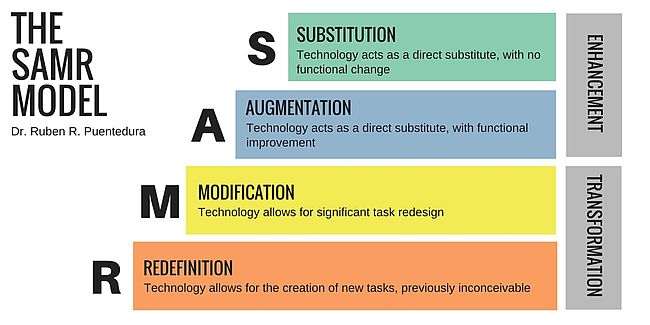
BELOW is an example of how an educator integrates SAMR into their lesson.
Lesson: Art/Painting
Original Assignment: Drawing a picture using traditional brush, paint, paper. Of course, there is a a big difference between doing this “by hand” in the traditional manner and doing it digitally – digitally is by no means “better”, it is just different and opens up some interesting possibilities.
Substitution: Use a digital drawing/painting program (like MS Paint) to draw/paint a picture.
Augmentation: Use a tool that allows the creation of your masterpiece to be “played back” (like Educreations, for example).
Modification: Pull a background image to use as a “canvas” – you could even scan something hand drawn and use that.
Redefinition: Create Artwork Collaboratively using a Collaborative Online Whiteboard (like Twiddla or one of these other tools).
5E's Instructional Model
The 5Es are an instructional model encompassing the phases Engage, Explore, Explain, Elaborate, and Evaluate, steps which educators have traditionally taught students to move through in phases.

- The teacher or a curriculum task accesses the learners’ prior knowledge and helps them become engaged in a new concept through the use of short activities that promote curiosity and elicit prior knowledge. The activity should make connections between past and present learning experiences, expose prior conceptions, and organize students’ thinking toward the learning outcomes of current activities.
Exploration
- Exploration experiences provide students with a common base of activities within which current concepts (i.e., misconceptions), processes, and skills are identified and conceptual change is facilitated. Learners may complete lab activities that help them use prior knowledge to generate new ideas, explore questions and possibilities, and design and conduct a preliminary investigation.
Explanation
- The explanation phase focuses students’ attention on a particular aspect of their engagement and exploration experiences and provides opportunities to demonstrate their conceptual understanding, process skills, or behaviors. This phase also provides opportunities for teachers to directly introduce a concept, process, or skill. Learners explain their understanding of the concept. An explanation from the teacher or the curriculum may guide them toward a deeper understanding, which is a critical part of this phase.
Elaboration
- Teachers challenge and extend students’ conceptual understanding and skills. Through new experiences, the students develop deeper and broader understanding, more information, and adequate skills. Students apply their understanding of the concept by conducting additional activities.
Evaluation
- The evaluation phase encourages students to assess their understanding and abilities and provides opportunities for teachers to evaluate student progress toward achieving the educational objectives.
ADDIE
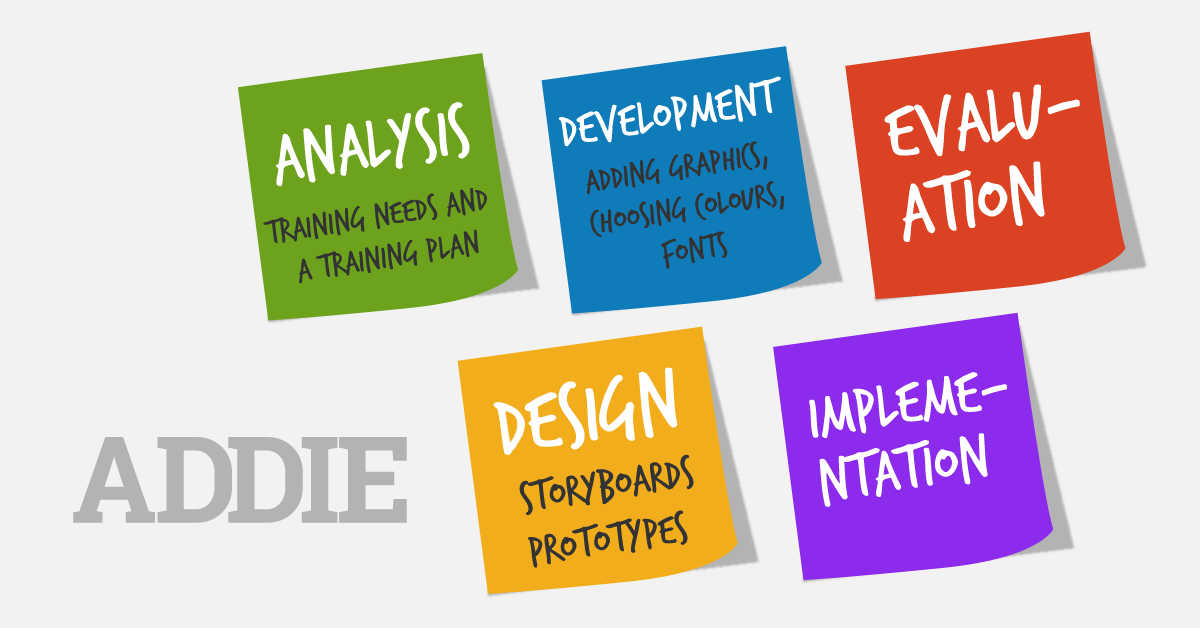
Addie is an acronym for the five stages of a development process: Analysis, Design, Development, Implementation, and Evaluation. The ADDIE model relies on each stage being done in the given order but with a focus on reflection and iteration.
Analysis Phase
- In the analysis phase, instructional problem is clarified, the instructional goals and objectives are established and the learning environment and learner’s existing knowledge and skills are identified. Below are some of the questions that are addressed during the analysis phase:
Design Phase
- The design phase deals with learning objectives, assessment instruments, exercises, content, subject matter analysis, lesson planning and media selection. The design phase should be systematic and specific. Systematic means a logical, orderly method of identifying, developing and evaluating a set of planned strategies targeted for attaining the project’s goals. Specific means each element of the instructional design plan needs to be executed with attention to details.
Development Phase
- The development phase is where the developers create and assemble the content assets that were created in the design phase. Programmers work to develop and/or integrate technologies. Testers perform debugging procedures. The project is reviewed and revised according to any feedback given.
Implementation Phase
- During the implementation phase, a procedure for training the facilitators and the learners is developed. The facilitators’ training should cover the course curriculum, learning outcomes, method of delivery, and testing procedures. Preparation of the learners include training them on new tools (software or hardware), student registration.
- This is also the phase where the project manager ensures that the books, hands on equipment, tools, CD-ROMs and software are in place, and that the learning application or Web site is functional.
Evaluation Phase
- The evaluation phase consists of two parts: formative and summative. Formative evaluation is present in each stage of the ADDIE process. Summative evaluation consists of tests designed for domain specific criterion-related referenced items and providing opportunities for feedback from the users.


No comments:
Post a Comment